The Estrobolome, Explained: How Your Gut Bacteria Control Estrogen Recirculation
The Estrobolome, Explained:
How Your Gut Bacteria Control Estrogen Recirculation
Most women have never heard the word estrobolome, and there's no great reason for that, because it may be one of the more important gut concepts in your entire hormonal picture. If you read my email introducing it, you got the short version. Here's the rest of it.
A foundational concept before we get into the mechanism: your gut isn't just involved in digestion. It's an active participant in whether your estrogen stays cleared or gets recirculated. That single fact should add another perspective to how you think about gut health, estrogen dominance, and really, a lot of symptoms that may never have seemed connected before.
WHAT THE ESTROBOLOME ACTUALLY IS
The estrobolome isn't your whole microbiome. It's a specific subset of gut bacteria that produce an enzyme called beta-glucuronidase, and that enzyme has one very particular job related to estrogen metabolism.
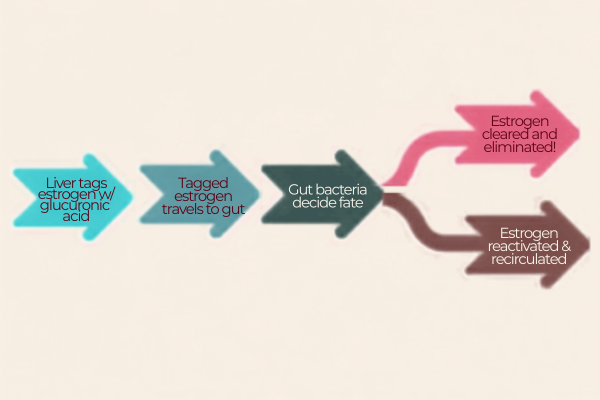
Here's the typical flow. Your liver processes estrogen through a series of detoxification pathways and attaches it to a molecule called glucuronic acid, a process called glucuronidation. Once estrogen is glucuronidated, it's tagged for exit. It travels through bile into the gut, ready to be eliminated in stool.
Under normal circumstances, that's where the story ends. The estrogen leaves.
But certain gut bacteria produce beta-glucuronidase, an enzyme that can cleave that glucuronic acid tag right back off. When that happens, the estrogen is deconjugated, meaning it becomes biologically active again, and it gets reabsorbed through the intestinal wall back into circulation instead of exiting the body.
Think of it as a recall notice getting intercepted before it reaches the warehouse. The item was packaged, labeled, and ready to ship out. Something at the loading dock decided to keep it instead.
WHY THIS MATTERS MORE THAN IT SOUNDS
A little beta-glucuronidase activity is normal and even useful. This isn't a system that's supposed to be fully shut off. The problem is a matter of degree.
When beta-glucuronidase activity is elevated, which happens with certain patterns of gut bacteria overgrowth or imbalance, more estrogen gets deconjugated and reabsorbed than your body actually needs back in circulation. That reabsorbed estrogen adds directly to your overall estrogenic load, on top of whatever your ovaries and adrenal tissue are already producing.
This matters specifically because reabsorbed estrogen isn't a diluted, secondhand version of the original. Once beta-glucuronidase cleaves off that glucuronic acid tag, the estrogen molecule is fully reactivated. It's not a faded copy. It's the same biologically active hormone, back in circulation, ready to bind receptors exactly like it did the first time.
Here's the kicker. Your body's feedback systems were designed around estrogen that reflects current production, not estrogen that already got the "you're done here" signal from your liver and didn’t take the hint. That reabsorbed estrogen still binds receptors, still sends signals, still adds to your total estrogenic load. Your body has no way of flagging it as recycled and treating it differently. As far as your tissues are concerned, it's simply more estrogen.
And there’s more. Some of the metabolites that get reabsorbed are also just as biologically active as the original estradiol, occasionally more so. So this isn't just extra estrogen circulating longer than it should. In some cases, it's a more provocative version of it, showing back up uninvited.
Here's where this gets frustrating on a practical level. A standard estrogen lab test can't tell you where that estrogen came from. Fresh ovarian production, adipose-derived estrone, and reabsorbed estrogen from an overactive estrobolome all show up as the same number on the same panel. So a woman with a disrupted estrobolome and a woman with a perfectly efficient one can have identical total estradiol but totally different symptoms, because the lab is measuring the sum, not the source.
For a woman already navigating the erratic estrogen swings typical of perimenopause, an overactive estrobolome adds one more layer of unpredictability to a system that's already drastically changing.
WHAT DRIVES BETA-GLUCURONIDASE ACTIVITY UP
A handful of specific bacterial genera are the main producers of beta-glucuronidase, including certain strains of E. coli, Clostridium, and Bacteroides. These aren't inherently "bad" bacteria. Most gut ecosystems contain some of them. The issue is overgrowth or an imbalance that lets their influence dominate.
Here's what tends to tip the balance:
Antibiotic use. I covered this in depth in Microbiome Mayhem, so I won't knock you over the head with the whole thing here, but it's worth restating in this context specifically. Antibiotics don't selectively spare beta-glucuronidase-producing bacteria. Depending on which strains survive a course of antibiotics and which get wiped out, the balance can shift in either direction, and spontaneous recovery isn't always fast or even complete.
Low fiber intake. Fiber does more than support regularity. It feeds the beneficial bacteria that help keep beta-glucuronidase producers in check, and it physically speeds up transit time through the gut. Faster transit means less opportunity for that enzyme to act on estrogen before it exits the body. When fiber intake is low, transit slows, and there's simply more time for deconjugation to happen.
A diet heavy in processed food. This shapes the overall bacterial terrain in a direction that tends to starve the “good guys” and favor the less helpful players. It’s the same pattern that shows up across nearly every gut health conversation.
Chronic constipation or slow motility. Independent of diet, anything that slows transit time gives beta-glucuronidase more contact time with estrogen before it leaves the body. This is one of the more underappreciated reasons constipation and estrogen dominance symptoms often travel together.
Dysbiosis more broadly. An imbalanced microbiome, whether from stress, illness, chronic low-grade inflammation, or years of accumulated gut disruption, tends to favor an environment where beta-glucuronidase-producing bacteria have more room to dominate.
Metabolic and adipose tissue factors. Research has linked higher levels of visceral fat, the metabolically active fat surrounding abdominal organs, with elevated beta-glucuronidase activity. This adds another layer to the relationship between visceral fat, estrone production, and overall estrogenic load we've discussed before.
WHAT THIS LOOKS LIKE SYMPTOMATICALLY
An overactive estrobolome doesn't announce itself clearly on a standard lab panel. What it tends to produce instead is a familiar cluster of estrogen dominance symptoms that can feel disproportionate to what your actual hormone production would suggest.
Heavier or more irregular periods. More pronounced PMS. Breast tenderness. Bloating that doesn't track cleanly with food. Mood shifts that feel hormonal even when the calendar doesn't quite line up. For some women, this shows up alongside chronic gut symptoms. For others, digestion feels essentially fine while the hormonal symptoms are the loudest signal.
This is part of why two women can have very similar total estrogen levels and completely different symptom pictures. One may have a well-functioning estrobolome efficiently clearing what needs to leave. The other may be reabsorbing a significant portion of it, day after day, without anything on a hormone panel pointing directly at the gut as the source.
WHAT ACTUALLY SUPPORTS A HEALTHY ESTROBOLOME
This is where the conversation tends to get oversimplified into "just eat more fiber," which isn't wrong, but it's incomplete.
Fiber, specifically the kinds that feed diversity. A wide variety of plant fiber sources, vegetables, legumes, whole grains, nuts, and seeds, supports a more diverse microbiome overall, which tends to keep any single bacterial group, including beta-glucuronidase producers, from dominating. Diversity matters more than any single "superfood" fiber source.
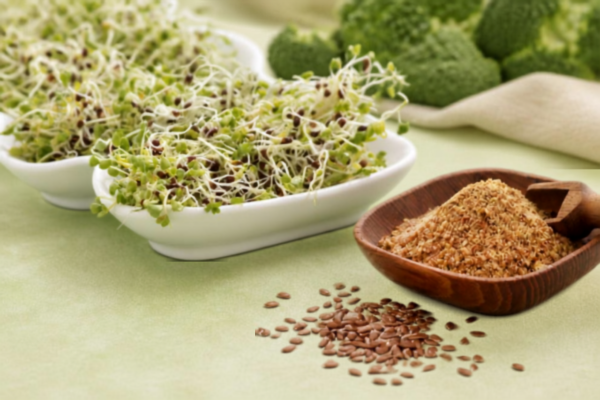
Lignans specifically. Flaxseed contains lignans that are converted by gut bacteria into compounds with a mild, favorable influence on estrogen metabolism. Two tablespoons of ground flaxseed daily is a small, well-studied habit that supports this pathway directly. One catch: it has to be ground. Whole flaxseed tends to pass straight through undigested, so you're not actually getting the benefit.
Cruciferous vegetables. Broccoli, cauliflower, Brussels sprouts, and cabbage support the liver's estrogen conjugation pathways in the first place, which means there's a cleaner, better-tagged estrogen molecule arriving in the gut for the estrobolome to deal with. Bonus tip: broccoli sprouts contain up to ten times the sulforaphane of mature broccoli, and they're super easy to grow right on your kitchen counter.
Calcium-D-glucarate. This is a compound your body produces naturally in small amounts, and it's also available as a supplement. It works by inhibiting beta-glucuronidase activity directly, which supports proper estrogen elimination rather than reabsorption. This is one of the more targeted interventions in this space, though as always, context and individual clinical guidance matter before adding any supplement.
Probiotics, with some nuance. Certain probiotic strains have research support for helping shift the microbial balance away from beta-glucuronidase-dominant patterns. This isn't about taking any probiotic on the shelf. Strain specificity matters here more than it does in a lot of gut health conversations.
Supporting motility. Adequate hydration, regular movement, and addressing constipation directly all reduce the amount of time estrogen spends sitting in the gut where beta-glucuronidase can act on it.
Reducing unnecessary antibiotic exposure. Not avoiding antibiotics when they're needed, but being thoughtful about when they're truly necessary, and supporting gut recovery deliberately afterward rather than assuming things will sort themselves out.
WHY THIS TIES EVERYTHING TOGETHER
If you've been reading along, this connects back to nearly everything we've covered. Liver estrogen metabolism determines how well estrogen gets tagged for exit in the first place. Xenoestrogen exposure adds to the liver's overall workload, leaving less capacity for efficient conjugation. Chronic stress affects gut motility and the microbiome directly. And now the estrobolome determines whether that properly tagged estrogen actually makes it out the door or gets pulled back into circulation at the last step.
None of these systems work in isolation. That's actually one of the beautiful things about physiology. Your gut isn't a separate conversation from your hormones. For estrogen specifically, it's one of the last checkpoints before your body decides whether that hormone is truly finished doing its job.
If your gut and your hormones have felt like two separate mysteries, this is usually where they turn out to be the same one.
Sources: This post draws on research examining beta-glucuronidase activity and estrogen deconjugation in the gut microbiome, the role of dietary fiber and lignans in estrogen metabolism, and the relationship between dysbiosis and estrogen dominance, published in journals including the Journal of Steroid Biochemistry and Molecular Biology, Gut Microbes, and the American Journal of Clinical Nutrition.
